
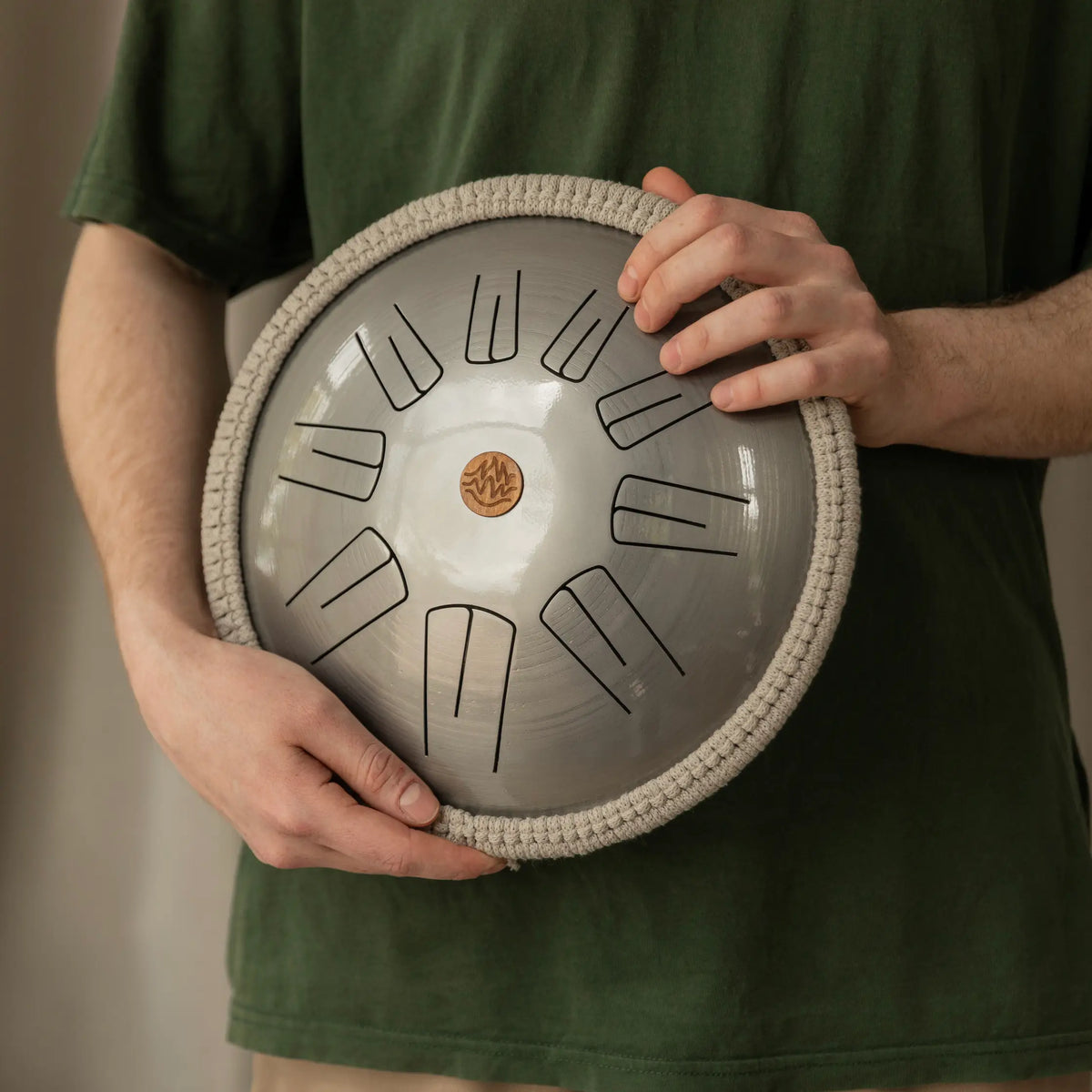
Choosing a steel tongue drum is easier than it might seem.
And yes, this is one of those rare instruments you can genuinely enjoy before you know how to play it properly.
You do not need music theory, years of practice, or perfect coordination before the instrument starts to feel rewarding. In my experience, even people who are convinced they are "not musical", - usually need only a few minutes before they start finding rhythms and realizing that they can actually create music easily.
So if you are wondering how to choose your first tongue drum, my short answer is simple:
Don't chase the biggest size or the maximum number of notes. A good beginner tongue drum should remove obstacles.
Clear note layout, intuitive scale, accurate tuning, comfortable size and a sound that makes you want to play the next note.
That first experience matters.
A good first instrument should not make you feel that you need to understand everything before you begin. But should invite you to explore!
I have often seen skeptical friends and relatives sit down at a tongue drum just to give it a try, and then keep playing like children who had discovered a new toy.
I also receive many messages from first-time customers sharing that they didn't expect it to be so easy. And, to be honest, it's a wonderful feeling to experience other people's joy.

This guide covers what I would actually look for in a first steel tongue drum:
From the number of notes and scale - to size, tuning, playing technique, and the common mistakes worth avoiding.
So, let's get started!
What Makes a Good Steel Tongue Drum for Beginners?
As mentioned, a beginner-friendly steel tongue drum is simply an instrument that dissolves the barriers between you and the music.
For me, that usually means several things working together:
- Intuitive note layout
- Scale that is easy to explore
- Accurate tuning
- Manageable dimensions
- Responsive tongues
- And a sound that still feels pleasant when you are playing something very simple
No single specification can replace the whole.
A drum may have dozens of notes and still feel confusing. It can be beautifully finished and still sound unpleasant. It can look large and impressive in a product photo but feel awkward to use every day.
The opposite can also be true.
A compact tongue drum with well-arranged notes, a coherent scale and accurate tuning can feel much more complete than something twice its size.
This is also why I do not think "beginner-friendly" should mean temporary.
A good first instrument should be easy enough to enjoy now, but good enough that you do not outgrow it once your playing improves. That distinction is important.
Common Mistakes When Choosing Your Very First Drum
There are three things first-time buyers often overvalue:
Size, number of Notes, and Price.
But none of those things guarantees a better instrument.
All three may look convincing on a product page:
- A bigger drum appears more serious
- More notes look like more possibilities
- And a low price feels like a safe way to "just try" a tongue drum
Bright finish, nice pattern, attractive price and Impressive promotional video...
The actual instrument arrives and suddenly, the sound has very little in common with what created the desire to buy it.
Sometimes we jokingly call some decorative drums "metal souvenirs", - objects that are visually appealing but lack value in terms of sound.
This first impression can be particularly disappointing for a beginner.
An advanced player may recognize that the instrument itself is causing the problem.
However, a first-time player may simply think: «Maybe I'm just not for this».
So before comparing specifications, I would start with a different question:
Does this instrument make sense as a musical object?
Then the numbers begin to matter.
How Many Notes Should a Beginner Tongue Drum Have?
More notes give more options. They also give more decisions.
For a first tongue drum, I personally find that full range 10-notes layout (9+1) is a very successful and comfortable balance.
That is not a universal rule. It is simply the configuration I keep coming back to after years of making steel tongue drums and talking with clients and players.
Ten notes give you enough range to build melodies, repeat patterns and explore different combinations without turning the playing surface into a map you constantly have to decode.
The note layout matters just as much as the total number of notes.
Ten thoughtfully arranged notes can feel much more natural than fifteen notes placed in a difficult way. This is one reason I always recommend looking at the note map before buying, rather than focusing only on the number in the product title.
For a beginner, the goal is not to own the maximum possible number of notes.
But it is to understand the instrument quickly enough, so the notes begin to feel connected.

There is also a practical advantage:
Many steel tongue drum lessons and beginner tutorials online use similar note counts and layouts, which makes it easier to follow along when learning your first patterns or melodies.
Should Beginners Play a Tongue Drum With Hands or Mallets?
In most cases, I recommend starting with mallets.
They give you a clear attack almost immediately, which means you can focus on rhythm and melody instead of worrying about striking technique.
Playing a steel tongue drum with your hands is slightly different:
Most of us spend our days touching screens, keyboards and buttons that respond to tiny movements. A tongue drum is still a percussion instrument, where steel needs a short and controlled strike, rather than a press.
The first few attempts can feel surprisingly unfamiliar:
Your dominant hand may sound cleaner. The other hand may seem to have temporarily forgotten that it belongs to the same person.
That is normal. And it improves with practice:
Playing by hand is not especially difficult once you begin to understand the movement. Over time, it also becomes a satisfying way to develop timing, coordination and independence between both hands.
My practical recommendation is simple:
Use mallets first and enjoy the instrument right away. Switch to playing with your hands later, when you're ready to explore further.
Watching experienced players can help too. Sometimes it is easier to repeat a movement visually than to understand it from instructions.

What Is the Best Tongue Drum Scale for Beginners?
This can get tricky, so I would not overcomplicate things for your first instrument:
Choose your first tongue drum scale not through music theory, but by listening and feeling.
There are several scales I repeatedly find easy to understand and rewarding to play:
*the descriptions are subjective
| Scale: | Character: |
| Celtic Minor/ Amara/ Kurd | Calm and balanced |
| Major | Bright, open and positive |
| Pygmy | Cosmic and meditative |
| Akebono | Spacious and emotional |
- Celtic Minor family is probably the one I would describe as the most balanced scales. It can sound calm without becoming too dark, and emotional without forcing every melody into one mood.
- Major is brighter. On paper, the difference between minor and major may seem insignificant, but even one changed scale degree can noticeably affect the emotional direction of the instrument's sound.
- Pygmy feels more dreamy and meditative to me, as if sound were turning into weightlessness.
- Akebono has a similarly intuitive quality, yet it has a distinct, melancholic character, a sound that evokes deep emotions.
More characterful scales such as Hijaz, Mystic and related variations – can also be beautiful. I simply find them less neutral as a first musical starting point.
That does not make them difficult or inferior, they just have a stronger personality.
For a first instrument, I usually recommend choosing a scale that gives the player more space to discover their own.
What Size Steel Tongue Drum Is Best for Beginners?
You're probably eyeing the biggest one?
I understand why.
At first, it seems to make sense.
Many people discover this whole family of instruments through handpan videos first, and handpans are physically large instruments. Their dimensions are a real part of their construction, so it is easy to carry the same logic over:
"Bigger instrument = deeper sound = better instrument".
This stereotype heavily impacts beginners choosing their first steel tongue drum.
With these drums, – it does not work quite that simply.
A large size makes sense when it is doing actual musical work.
Big tongue drum can be excellent when the maker is actually using that extra space musically:
Adding a wider range, working with low notes, balancing additional overtones and designing the entire instrument around those dimensions.
But if the same basic 9+1 layout is simply stretched across a much larger shell, the main differences may end up being more weight, less portability and a higher price.
For a first steel tongue drum, I generally prefer compact or medium dimensions:
They are easier to place on your lap, easier to carry outside, to travel with and to keep nearby at home.
Furthermore, a compact tongue drum does not automatically mean a limited sound.
I have had customers contact me specifically looking for a larger instrument, then choose a compact Spark v2 instead and later write back surprised by how rich and deep it sounded in person.

Sometimes the instrument you actually pick up and play is more useful than the one with the most impressive measurements.
That is also why experienced players often keep compact instruments even after buying larger drums.
440 Hz vs 432 Hz for Your First Tongue Drum Instrument
This question comes up often, especially among people interested in meditation, yoga and relaxation.
The practical answer is simpler than the internet sometimes makes it sound.
440 Hz and 432 Hz are different reference tuning standards.
If you already prefer a 432 Hz tongue drum, or that pitch has personal significance for the way you plan to use the instrument, there is nothing wrong with choosing it.
But if you have no strong preference – I recommend going with 440 Hz.
It is the more practical default if you plan to play together with commonly tuned instruments such as guitar or piano.
One thing I definitely wouldn't do is choose an instrument of inferior quality simply because the title promises something like "432 Hz Healing Drum".
That number does not automatically make a tongue drum sound deeper, better or more therapeutic.
We have a separate comparison, including real sound examples, if you want to explore the difference further:
440 Hz vs 432 Hz: What’s the Difference?
How to Tell If a Steel Tongue Drum Is Good Quality
Let's suppose that a friend asked me to evaluate a tongue drum from any given manufacturer.
I would check five things:
- Listen to a real tongue drum recording. Not just one polished promotional clip.
A real sound sample should tell you much more than a product description.
Try to hear individual notes and ordinary playing without music layered underneath.
If possible, use headphones.
- Check the note layout.
A good tongue drum layout should make movement between notes feel logical rather than random. This becomes much more important in everyday playing than the number printed in the description. - Ask yourself whether the size has a purpose.
If the steel tongue drum is large, what is that size actually giving?
Low notes/ A wider range/ More complex resonance... Or simply a larger body? - Check the material and construction.
Different steels and manufacturing methods create very different tongue drums.
You do not need to become a metallurgist, but it is worth knowing what the instrument is made from, how it is assembled and whether it requires special care against corrosion.
*Consider that drums with oil treatment may cause inconvenience when the instrument comes into contact with clothing.
- Look for evidence of real tuning and quality control.
A steel tongue drum is not only shaped metal, it is a tuned musical instrument.
Real workshop photos, actual recordings, information about the tuning process and clear manufacturing details usually tell you much more than a long list of marketing adjectives.
If those five things make sense, you're already on the right track to making a truly informed choice, going well beyond just size, color, and price.
Learn more in our article:
Why Steel Tongue Drum Tuning Quality Matters
Why Spark V2 Works as a First Steel Tongue Drum
Everything above also explains a lot about how Spark v2 developed.
I did not start with the idea of making a "beginner tongue drum".
But I just wanted to make a compact steel tongue drum that still felt complete:
- Clear 9+1 note layout
- Extensive capabilities to explore without turning the instrument into a puzzle
- Compact enough body to carry easily
- Range of scales with very different moods
- And tuning quality that would still matter after the first excitement of owning the instrument had passed
A huge part of the development was fitting that 9+1 layout into a compact body properly.
I spent more than a year working through different versions before I was satisfied with the balance.
That is probably why this model also ended up working so naturally as a steel tongue drum for beginners.
But I do not think of Spark v2 as something a player is supposed to outgrow.
That would defeat the point.
A person may later buy a larger Ember model, a handpan or several other instruments.
The Spark drum remains the perfect companion for travels, cozy days at home, warm backyard evenings, or simply unwinding to the comfort of a familiar rhythm.
A first instrument does not need an expiration date.
If you want to compare all available tunings and finishes:
Explore the Spark v2 Steel Tongue Drums
Or, If you would rather skip the full catalog,
Here is a curated selection of beginner-friendly steel tongue drums and scales:
Explore Steel Tongue Drums for Beginners
One Last Piece of Advice
Look for a drum that offers more than just a low price, large size, or bright design.
While such parameters may look important, they shouldn't be the only reasons.
Listen to it, look at the note layout.
Think about where you will actually play it.
And choose the instrument that makes you curious about what the next note will sound like.
A good first steel tongue drum should not feel like homework.
It should make you want to reach for it again tomorrow.
In my opinion, that's a more meaningful definition of the best beginner-friendly tongue drum than what you'd typically find on product labels.
If that happens, well-chosen notes can give you years of music.
Ready to Choose Your First Steel Tongue Drum?
If you would prefer a shorter path through all the available options, I have put together a curated selection of scales and instruments that I personally consider especially comfortable for first-time players.
These are not simplified or disposable "beginner instruments".
They are full-quality steel tongue drums chosen because their layout, scale, size and overall playing experience make it easier to enjoy your first steps – while still giving you an instrument you can keep for years.
Explore Steel Tongue Drums for Beginners
Quick FAQ: Choosing Your First Steel Tongue Drum
-
Is a steel tongue drum good for beginners?
Yes. A steel tongue drum is one of the more accessible melodic instruments for a complete beginner because the notes within a well-designed scale naturally work together. You can start experimenting with simple rhythms and melodies without knowing music theory first. -
How many notes should a beginner tongue drum have?
There is no universal ideal number, but I personally find 9+1 (10 notes in total), to be an excellent balance for a first tongue drum. It provides enough musical range to explore without making the layout unnecessarily complicated. -
What is the best tongue drum scale for beginners?
I usually recommend starting with an intuitive scale such as Celtic Minor / Amara, Pygmy, Akebono, or Major. They all have different moods, so the best choice depends less on music theory but more on which sound you naturally enjoy listening to. -
What size steel tongue drum is best for a beginner?
For most beginners, I prefer a compact or medium-sized tongue drum rather than simply choosing the largest instrument available. A larger body is useful when it supports a wider musical range, lower notes, or a design that genuinely benefits from the extra space. Size alone does not guarantee better sound. -
Should a beginner choose a 432 Hz or 440 Hz tongue drum?
If you have no strong preference, 440 Hz is the more practical default, especially if you want to play with other commonly tuned instruments. If you specifically prefer 432 Hz for personal, meditation, or relaxation use, it can also be a perfectly reasonable choice.
440 Hz vs 432 Hz: The Difference -
Is it easier to play a tongue drum with hands or mallets?
Mallets are usually easier for a complete beginner because they produce a clear sound almost immediately. Playing by hand takes a little more control and practice, but it is very learnable and can become a natural next step once you are comfortable with the instrument.


Leave a comment
This site is protected by hCaptcha and the hCaptcha Privacy Policy and Terms of Service apply.