
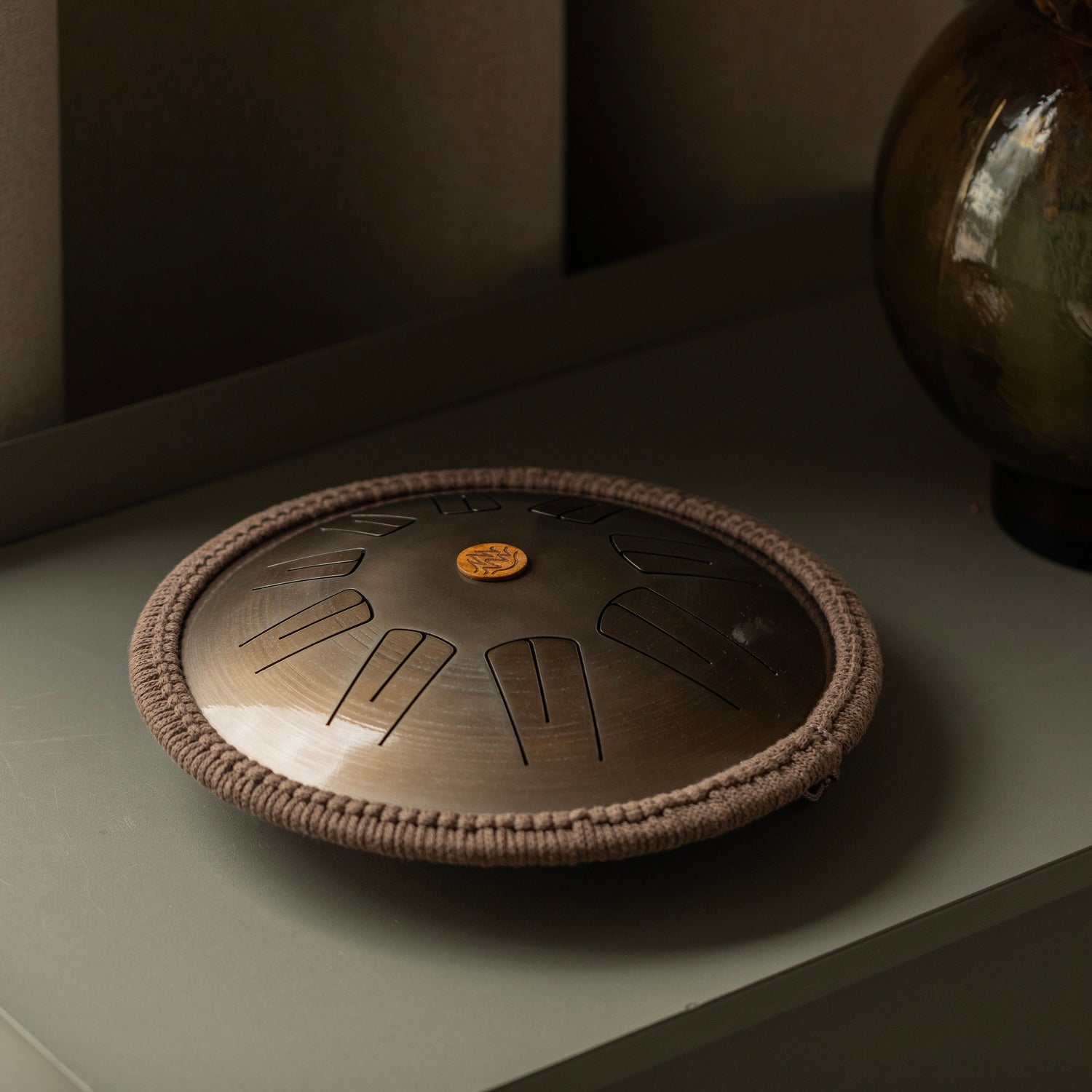
«Why Tuning Quality Matters More Than You Think»
Today I want to talk about one of the most important and most misunderstood aspects of Steel Tongue Drum: The quality of tuning.
This thought has been on my mind for a long time. It's also one of the questions I hear most often from clients. And to be honest, it's not something you can answer in a sentence or two.
“Tuning quality?”
We usually think in much more tangible terms like: steel grade, dimensions and sizes, design of an instrument...
These things are easy to see and describe.
But what we think about far less is this:
- What actually determines whether an instrument sounds harmonious — or not.
This article will be especially useful for those, who are looking for sound, atmosphere, and feeling.
If you are simply looking for an object, - perhaps this topic may seem less important for you.
«A Real Case: Two Similar Steel Tongue Drums, But Not»
A few days ago, I received a message from one of our clients:
Peter from Canada wrote to say that he had received his new instrument from our Burning27 workshop — the Ember model in the Silver Flame design.
And he was genuinely impressed with the sound quality and, interestingly, decided to compare it with another steel tongue drum he already owned — a mass-produced model.
Peter recorded a simple, honest comparison video:
First playing the new instrument, then the other one standing right next to it.

Of course, it was a pleasure to receive such feedback. And I'm sincerely grateful to Peter for allowing me to share his video.
At the same time, if I'm being honest, - the result felt quite natural. Considering our approach to tuning and instrument making.
Many people don’t realize, that even when two tongue drums or handpans may look very similar on the outside, have nearly the same size and the same quantity of notes. Yet they can sound completely different. And this becomes obvious the moment you begin to understand what really stands behind proper tuning.
That's exactly what I'd like to talk about in more depth.
«What a Steel Tongue Drum Really Is (In Simple Terms)»
Let's briefly recall what a steel tongue drum actually is.
In simple terms, it consists of two convex steel shells joined together with a sealant.
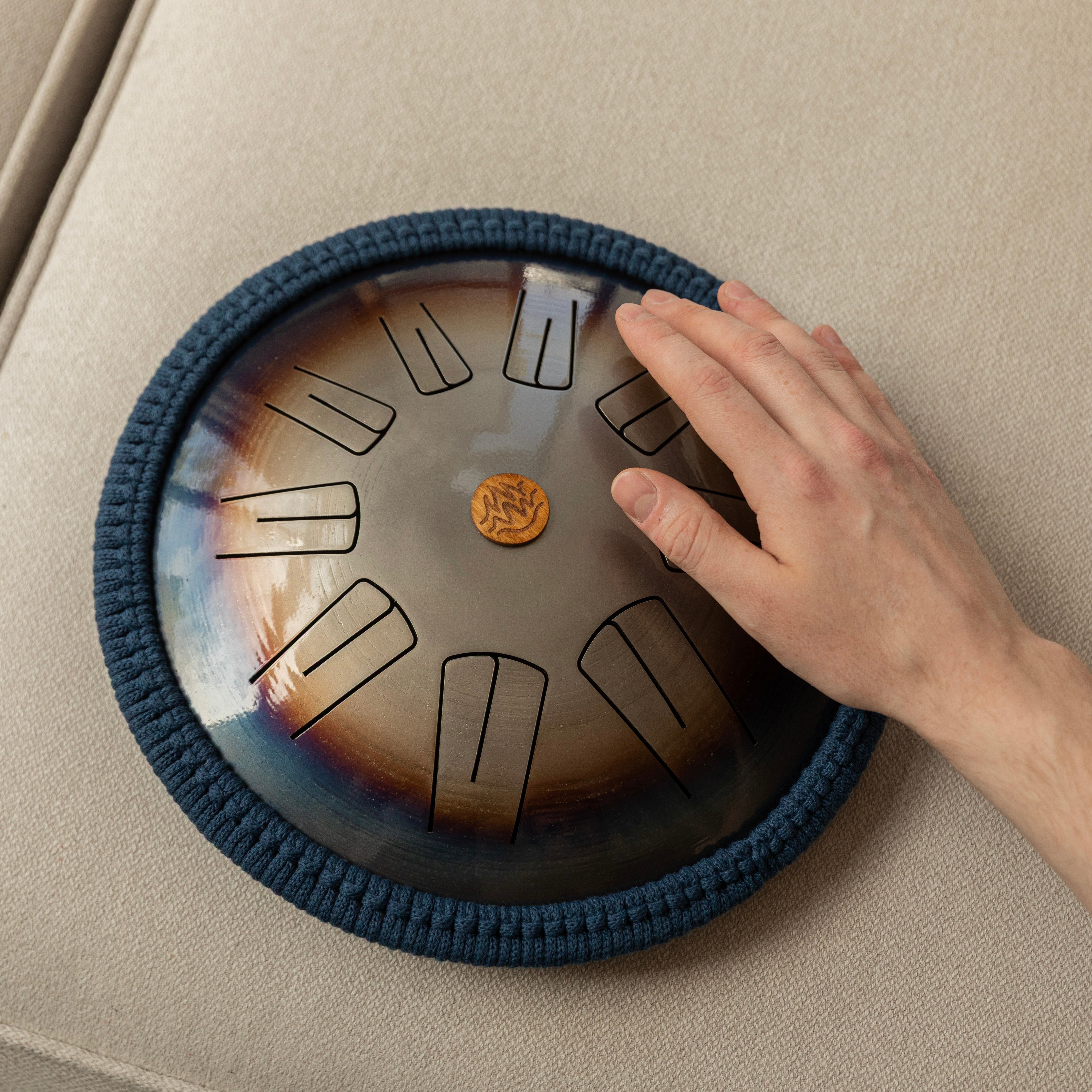
- The upper shell has cut-out sections — often called tongues or petals.
These are the parts that are tuned to musical notes. - The lower shell usually acts as a resonator, shaping volume and depth.
Interesting fact:
The notes on a steel tongue drum are not tuned in a linear order like on a piano. Instead, they are tuned according to specific musical scales.
In practice, this means that each note must not only be correct on its own, but also interact harmoniously with all other notes on the instrument. Thanks to this - it's possible to play instrument even without musical education — it's surprisingly hard to play a “wrong” note.
In essence, steel tongue drum is a unique combination of:
- percussion and melody
- calming and atmospheric sound
- accessibility and musicality
And here is a key point:
The balance of the entire instrument, together with the precision of tuning, - creates up to 90% of its perceived quality and how the instrument feels and sounds.
That's why tuning is a slow, careful, and iterative process, - often involving multiple passes with a tuner and constant rechecking by ear.
Ask yourself a simple question:
Is precise tuning important here?
The answer is obvious.
«When Tuning Is Off, — the Instrument Loses Its Soul»
Without proper tuning, a harmonious instrument turns into a metal object and the philosophy of the instrument collapses.
Attractive on the outside — empty on the inside.
Without depth. Without those “healing vibrations” people love to talk about.
«Video Comparison: Listening to the Difference»
Let’s return to the video Peter shared.
You don't need a trained musical ear here. I would like to guide your attention to a few specific details that help distinguish tuning quality.
First, Peter plays the Burning27 drum.
The sound is stable and clean, without beating or dissonance. The notes feel as if they are singing together. Each supports the instrument's character.
Notice the body as well - it resonates without interfere. The body always resonates, but when tuned correctly, - it works with the notes, not against them.
Then Peter plays the second drum — the Black one.
Same room - Same surface.
Same player - Same rhythm.
Now listen closely:
- Do you feel a unified sound, or scattered frequencies?
- Is there unwanted metallic noise?
- Does the vibration start to “press” on the ear?
- How long does each tongue sustain?
- Do the notes feel connected, or isolated?
- And finally — is it pleasant to listen to?
The difference becomes clear very quickly.
This is not about brands.
It's purely about tuning quality.
«Why Tuning Is Important for Relaxation and Meditation»
Many people choose steel tongue drum or handpan instruments not just for fun, but for their individual needs.

For example, I often encounter requests when a client is looking an instrument for:
- sound therapy
- relaxation, stress relief
- meditation with intuitive playing
In this context, tuning becomes especially important.
Let's look at two simple examples:
Inaccurate tuning:
- distracts attention
- creates tension instead of calm
- interferes with breathing and focus
Precision tuning:
- allows the mind to settle
- supports flow and presence
- feels stable and calming, supports slower breathing
That's why tuning is not a technical detail.
It directly shapes the emotional experience of the instrument.
«Even New Steel Tongue Drum Can Sound Out of Tune»
Mass production vs Handmade
A natural question follows:
How is it possible that some instruments sound inaccurate even when they're brand new?
The answer is simple — Approach to making.

Broadly speaking, manufacturers fall into two categories:
- Mass production
- Handmade workshops
- In the first case, - the entire manufacturing process can take around 30 minutes. The result is a steel shell with a set of random pitches.
- With a right approach - tuning is performed multiple times, at different stages, with constant checking.
Why do some brand-new steel tongue drums arrive already out of tune?
The answer lies in knowledge + time.
At Burning27, we make up to 40 instruments per month. Not because we are slow, but because each instrument goes through multiple individual steps and quality checks.
You will not see this processes on photos — but you will absolutely hear and feel it real.
Over time, we realized that this is part of our philosophy.
«How to See Tuning Accuracy: Using a Tuner»
Here I would like to show how tuning accuracy can be visualized using a sound tuner.
In music, an electronic tuner is a device that detects and displays the pitch of musical notes played on a musical instrument. "Pitch" is the perceived fundamental frequency of a musical note, which is typically measured in hertz.
Simply put, - a tuner is a device used to measure the frequency of notes.
It is widely used not only to check tuning, but also during the tuning process itself.
Look at these images:

- On the left, the needle sits perfectly in the center — the note is in tune.
- On the right, the needle drifts — this indicates an out-of-tune note.
Two important details:
- Every note has acceptable tolerances (usually ±5 cents).
- Exact values depends on the tuning standard used. Commonly 440 or 432 Hz.
This means every note has a precise target frequency.
And yes, you can check how your instrument is tuned.
«Why So Many Steel Tongue Drums Sound Out of Tune»
While exact global statistics do not exist, it is possible to estimate the overall picture by looking at mass marketplaces, production methods, pricing, and tuning consistency.
Based on my experience, as a maker, and dozens of instruments I've seen and heard over the years, - the steel tongue drum market today is unbalanced.
A large portion of the drums are out of tune. I would estimate it at around 60%.
This suggests that a large proportion of available drums on the market are produced with minimal tuning effort, which helps explain why many instruments sound out of tune straight out of the box.
And unfortunately - many buyers, especially beginners, won't recognize how a properly tuned instrument should sound.
Since this niche is still quite young, - people often assume that “this is just how it sounds”.
Below is a diagram for visualization:

Note: This distribution is an expert estimation rather than official industry statistics. The steel tongue drum market is still relatively young and lacks transparent global reporting.
- Handmade / Artisan (~15-25%)
- Mid-tier Tuned (~10-20%)
- Mass-produced / often untuned (~55-75%)
The largest share is occupied by mass-produced drums, where tuning accuracy is often inconsistent or ignored entirely. These instruments may look attractive but frequently lack harmonic balance and long-term stability.
A smaller portion belongs to mid-tier instruments — partially tuned drums that aim for better sound but still rely on industrial processes.
Finally, only a relatively small segment of the market consists of truly handmade instruments, where tuning is done individually, checked multiple times, and treated as the core of the instrument, not as a secondary step.
Add to that:
- layered audio in promotional videos
- lack of honest comparisons
- a low entry barrier
The result?
An instrument that feels interesting at first, but over time loses its charm. It ends up on a shelf — sometimes taking the owner’s interest with it.
Yes, the most unfortunate part is that people may think all steel tongue drums sound like this — and completely lose interest in these instruments.
«How to Choose a High-Quality Steel Tongue Drum»
If you are currently choosing your first steel tongue drum (or handpan), please - make a well-balanced choice.
Here are some practical tips, worth paying attention to:
- If the same product appears on many websites: It is likely a mass-produced.
- Listen to sound first. Try to find multiple videos of the same instrument.
- Check forums and independent review-platforms.
- Use AI assistants like ChatGPT to help discover handmade brands.
- Expect a realistic price — a well-made instrument rarely costs less than 200 USD.
- The market has not yet reached a stage where large factories produce quality drums.
Most importantly — the instrument should resonate with you.
And, of course, you're always welcome to explore Burning27, if you're looking for a balanced handmade instrument.
Over time - I've noticed that many people discover my instruments through personal recommendations, including from musicians and enthusiasts who actively help others find a good balance between sound quality, craftsmanship, and price.
I'm genuinely grateful for that trust! And for us it reinforces the importance of focusing on sound first, not marketing labels.
«Final Thoughts»
Thank you for taking the time to explore this topic!
Hope this article helped you hear and understand steel tongue drums a little better.
As makers, we deeply appreciate when people approach their choice thoughtfully and become curious about the nuances.
Handmade work always felt. In any product.
Listen carefully.
Ask questions.
And trust not only your eyes.
If you ever need guidance or simply want to talk about sound, - you're always very welcome to reach out.
— Yakiv,
Handcrafted steel tongue drums with a special approach — Burning27 workshop.
Last note:
I'll leave you with a thought I find very accurate:
«The disappointment of a poor quality lasts much longer than the joy of a low price»

Leave a comment
This site is protected by hCaptcha and the hCaptcha Privacy Policy and Terms of Service apply.